
Clay is not disposablel: How to recycle clay at home
There's a mistake many people make when they start making pottery ➜ throwing clay away. The piece is crooked, it's cracked in half, there's material left over from a session and it goes to waste. It makes sense in the logic of someone who has never worked with the material, but it's an unnecessary waste. Clay, to a certain extent, is totally recoverable.
The key point is this “up to a point”. There comes a point in the process when the clay stops being clay and becomes ceramic. From then on, there's no turning back. But before that moment, with the right method, almost everything can be recovered.
This article explains how to recycle clay at home, what you can't, and how the process works in practice.
⧗ reading time - 11 to 13 minutes ⧗
The point of no return
Clay goes through several stages from the moment it comes out of its packaging until it becomes a finished piece. If you're not familiar with these phases, it's worth reading the article on THE STAGES OF CLAY before continuing here, because what follows makes much more sense in that context.
What matters for this topic is a single point: the first firing. When the clay is fired in the muffle, an irreversible chemical transformation takes place. The clay particles fuse together, the structural water evaporates once and for all, and the material stops being clay and becomes clay. It doesn't fall apart. A clay piece doesn't return to its plastic state, it doesn't dissolve in water, it doesn't give you another chance.
Before firing, clay behaves completely differently. It is a material that absorbs water, that can soften, that can be broken and put back together. The logic behind this is simple. Plastic clay is essentially very fine particles of clay mixed with water. When it dries, the water comes out but the particles are still there. When you get it wet again, the water comes back in and the process reverses. Not perfectly, not immediately, but reversed.
So everything that hasn't yet been baked can be recycled. Dried pieces, scraps, leftovers, hard clay in packaging, unfinished pieces, broken bits. All this is recoverable material.
How to recycle clay at home: The different situations and what to do in each one
1) Plastic clay you haven't used
It's the simplest case. You've used a clay container and there's still some pliable material left over. Simply store it well wrapped in plastic, preferably in a sealed bag. The aim is to keep it moist. In a well-sealed bag, and stored in a place that isn't exposed to the sun, the clay can last for weeks without deteriorating. If you notice that it's starting to harden around the edges, you can spray water into the bag.
2) Hard clay in the packaging
It happens when the plastic of the original packaging has been poorly sealed or when the block of clay has been waiting too long. The clay feels like a stone, it doesn't yield to finger pressure, it breaks instead of bending. It looks unusable, but it isn't.
The most direct method is to put the clay block in a bag with about 1/5 of its weight in water and close it. Then place the bag in a bucket or box filled with water, until it covers the volume of the bag containing the clay, and cover it.
Leave it for at least 48 hours and then check it. In principle, the water you put inside the bag will be enough to hydrate the clay, and the humid environment also contributes. If you see that it's still too hard, you can add more water. If it's too soft, you should let it dry to the consistency of plastic clay. Then you can knead it and it's ready to use.
3) Leather or bone parts
Leather is the stage when the clay is already firm but still has some flexibility. Bone is the next stage: completely dry and more fragile. The two phases are very different to work with, but for recycling purposes they are treated similarly.
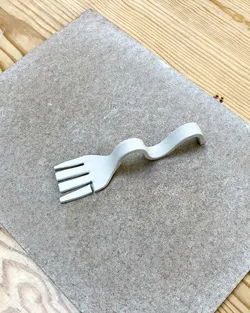
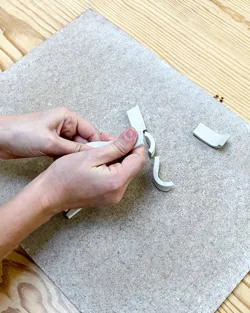
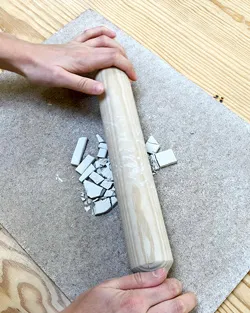
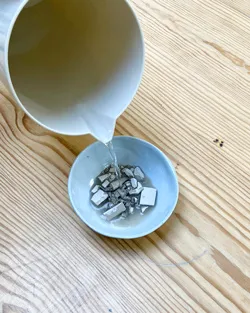
The process here involves breaking the pieces into small pieces, placing them in a bucket and covering with water. Contrary to what you might think, you don't need much liquid. Just enough water to cover the material. After a few hours (sometimes a day, depending on the thickness of the pieces), the clay will absorb the water and disintegrate into a very liquid paste, almost like mud.
The example in the pictures is just to illustrate the steps, as this is a very small amount of clay.
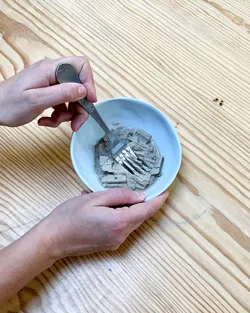
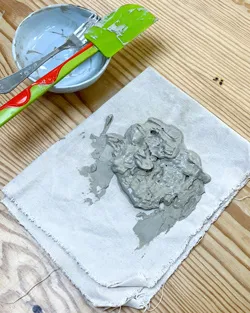
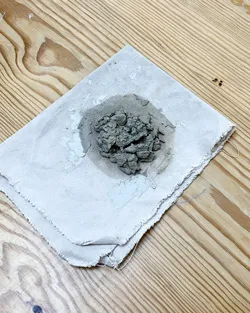
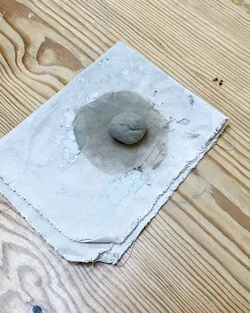
The next step is to remove the excess water. Plasterboard is ideal for this. Plaster is a porous material that gradually and evenly absorbs moisture through its pores. Pour the clay paste over the boards, spread it out and wait. The plaster will draw the water out of the clay over a few hours/days. When the clay is the right consistency, you remove it, knead it and it's ready to use.
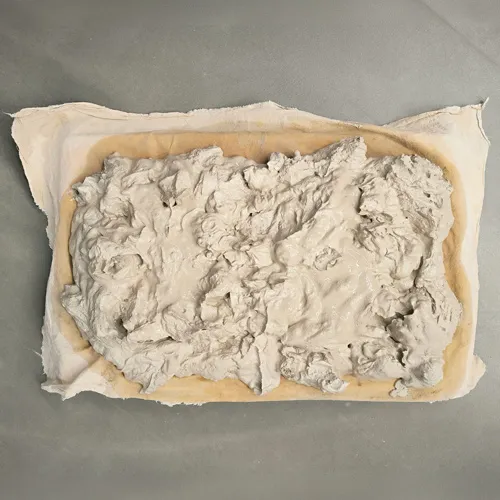
If you don't have plasterboard, you can use other absorbent materials such as thick cotton cloth. In small quantities, as in the example of the spoon (see images), it works well. For larger quantities, as in the following images, it may not work so well. Plaster is the right material for this.
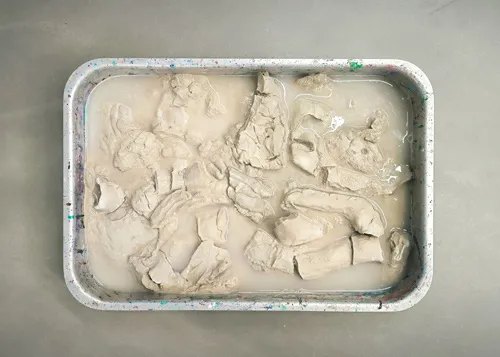
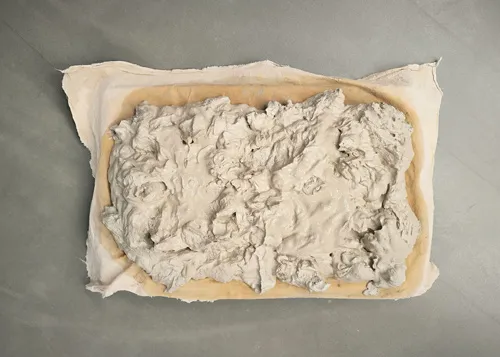
At FICA we use plasterboard, but also cotton cloths. As we use different types of clay and don't want to contaminate the plaster, we put a cloth over the plaster. Despite the extra layer, the plaster retains its functionality.
4) Scraps and leftovers
When you work clay, you will inevitably create leftovers. The excess you cut off when trimming a piece, bits that fall off while working, pieces that stick to the table. All this can go into a recycling bucket. Add water, wait for it to dissolve and treat it in the same way as the bone pieces.
An alternative for small quantities is to use the scraps to make lambugem. Lambugem is clay very diluted in water, with the consistency of thick yogurt, which serves as a “glue” to join parts of clay to leather. If you have small scraps, dissolving them in water to make lambugem is more practical than saving them for a full recycling cycle.
5) Clay with engobe applied
The engobe is a colored paste that is applied to the pieces before firing. If the clay you want to recycle already has engobe, there's an extra step. You need to remove the engobe before adding it to the rest of the material. Take a damp sponge and clean the surface before breaking the pieces into the bucket. You don't need to remove everything with surgical perfection, but the bulk should come off. Recycling clay with engobe mixed in can affect the color and consistency of the recycled clay.
6) What can't be solved: dull or glazed parts
A piece of clay looks fragile, but it has already undergone the chemical transformation of firing. You can break it, you can grind it, but it won't go back to being plastic clay. It won't dissolve in water. It doesn't soften. The material left over from a chacota piece goes to waste, or at most it can be used as chamotte (very fine fragments that are mixed into clay pastes to add texture) if you have the equipment to grind it finely. In a domestic or workshop context, it's not practical.
A glazed piece is the same, but even more definitive. The glaze has fused with the clay. There is no recovery possible.
The recycling process in a nutshell
For those who want to have this clear as a sequence:
➜ put the clay together to recycle in a bucket;
➜ cover with water;
➜ You wait for it to dissolve;
➜ lying on plasterboard;
➜ wait for the plaster to draw out the moisture until the consistency is right;
➜ Knead well to homogenize;
➜ store in plastic until used.
The time it takes depends on the amount of material, the thickness of the pieces and the room conditions (temperature, humidity). In practical terms, allow at least a day for the dissolving phase and another day for the plasterboard. It's not immediate, but it doesn't require a lot of active work on your part either. Most of the time you just have to wait.
There's an important detail when you knead. Recycled clay tends to have more irregular air pockets than new packing clay. Knead well, more than you think necessary, and if possible let it rest for another day wrapped up before using. Resting helps stabilize the moisture inside.
Is it worth recycling or is it too much work?
It depends on the context. If you make pottery at home, recycling makes perfect sense. Clay costs money, the recycling process requires no special equipment (apart from a bucket and plasterboard), and the quality of the result is perfectly usable.
If you're in a workshop with access to clay, the equation changes a little. The time and space that recycling takes up may not be worth it, especially in a learning context where the focus is on techniques, not material management.
At FICA, the leftover clay from the workshops doesn't go to waste. They are recycled and put back into circulation. Over the course of more than 170 public ceramics workshops in 2025, and 1200 participants, the amount of material that passes through the workshop is considerable. Not wasting makes sense from a practical and resource management point of view. And so there is clay that goes back into workshops or is used for productions.
And after firing? Can fired ceramics also be recycled?
We said above that the point of no return is the first cooking. This is true for the general context. But that doesn't mean that fired ceramics are a dead-end material. It just means that the recovery process is completely different, more demanding, and beyond the reach of those working on a small scale.
Fired ceramics are completely different because they don't dissolve in water and don't return to their plastic state. What makes fired ceramics difficult to recycle is exactly what makes it good as a material: it's chemically stable, hard, and doesn't react with water or most agents.
Recovering it requires processes that are beyond the reach of an ordinary workshop. To recover it, you have to grind it into a very fine powder, which can then be incorporated into a new ceramic paste as a filler material.
However, there are industrial and artisanal projects that have already worked on this, such as the IKEA and Granby Workshop.
Try this without pressure
If you want to understand how clay behaves in the different phases, the best way is to work with it. Reading about leather and bone is useful, but the difference becomes much clearer when you have the material in your hands and understand in practice what each phase allows or doesn't allow you to do.
Our ceramics workshops are a good place to start. You can see the available dates at fica-oc.pt/workshops-de-cerâmica
Frequently asked questions - how to recycle clay at home
Can I mix clays of different types when I recycle?
In principle, it's not a good idea. Different clays have different compositions, firing temperatures and behaviors. If you mix a stoneware paste with an earthenware paste, the result can have inconsistent properties and create problems when firing. The ideal is to keep the materials separate during recycling. If you're not sure what type of clay you're recycling, treat it as a separate batch and use it for lower-risk pieces.
Is recycled clay worse than new clay?
Not necessarily. Well recycled and well kneaded clay can work just as well as new clay. What can happen is that there are irregularities if the process has not been complete: wetter and drier areas, or air pockets due to lack of kneading. With care, the result is usable without any problems.
How long can I store recycled clay?
Indefinite, as long as it is well sealed in plastic and doesn't dry out. Some potters argue that “old” clay has better plasticity than fresh clay because the particles have more time to organize themselves. What you need to avoid is it drying out or getting contaminated (fungi, for example, which appear when there is excessive humidity and a lack of air circulation). If you see strange stains on the clay you have stored, you can remove them so that it doesn't expand.
Can I recycle clay with cracks without removing the engobe completely?
Cracks in the piece don't affect the recycling process: when the clay dissolves in water, the cracks are irrelevant. As for the engobe, you don't need a perfect clean, but removing the bulk is important if you care about the color of the recycled clay. A small amount of engobe mixed into the base clay won't ruin anything, but if the engobe is very pigmented and the amount is significant, the recycled clay may take on a different hue.
Do I really need plasterboard, or is there an alternative?
Plasterboard is the most efficient method because it draws out the moisture gradually and evenly. Alternatives exist: absorbent cotton cloth or simply wait longer with the clay exposed to the air. Any of these options works, but in a slower and less controlled way. If you make ceramics on a regular basis, you should make some plasterboards.
What happens if you bake recycled clay that still has moisture in it?
Moisture inside the clay during firing is dangerous. The water evaporates and expands, which can cause explosions in the kiln. It's not a risk specific to recycled clay, it's a risk for any piece that isn't dry enough. You can read more about this in the article on ceramic firing. The rule is the same: the piece must be completely dry before going into the oven.