
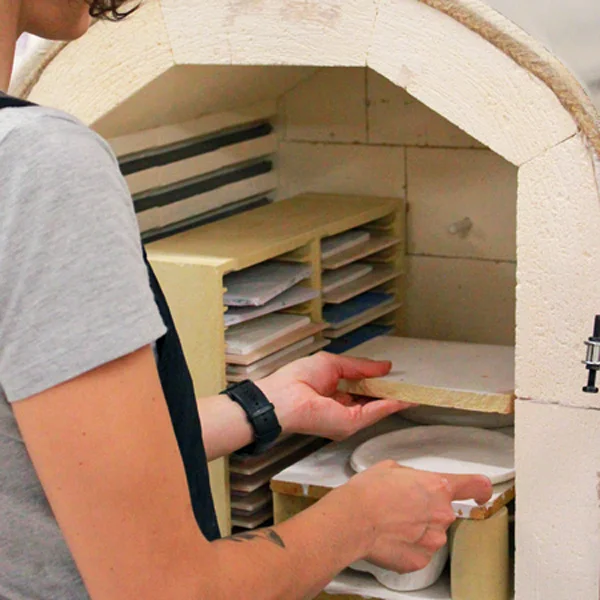
Ceramic firing: what happens to the clay in the muffle
There's one thing that everyone who starts out in ceramics learns sooner or later, and that's that firing is unforgiving.
You can recover clay that has dried out too much. You can correct a piece that has become crooked during the leather stage. You can redo almost everything, right up until the moment the piece goes into the kiln. From then on, the process is irreversible.
That's why understanding what happens inside the oven isn't optional knowledge. It's what allows you to make good decisions before you get there. In this article you'll find out what happens in ceramic firing.
⧗ reading time - 9 to 11 minutes ⧗
Why does clay need firing?
Clay, even completely dry, in its bone state, is a fragile and reversible material. It dissolves in water. It breaks with a moderate impact. It doesn't have the hardness or impermeability of ceramics.
What turns clay into ceramics is heat, but not just any heat. It's enough heat to cause permanent chemical and physical transformations in the clay particles. These transformations happen in stages as the temperature rises, and each one plays a role in the final result.
Domestic firing, even at ~300ºC, which is the maximum for a kitchen oven, isn't enough. The clay dries, but it doesn't turn into ceramic. It's still clay.
The two (or three) cooking ceramic
Most ceramic processes include two different firings, with different objectives. Here we've added an extra one.
1st cooking - Chacota
The first firing transforms the raw clay into chacota. It's a physical and chemical transformation: the water chemically bound to the clay particles is released, the particles partially fuse, and the clay becomes permanent, hard, stable, and impossible to reverse.
Shellac is porous. It's not impermeable, it still absorbs liquids. It is precisely this porosity that makes it ideal for glazing: the material is absorbed evenly over the surface, which facilitates homogeneous coverage.
First firing temperatures typically vary between 900ºC and 1000ºC, depending on the type of paste. Even high-temperature pastes, such as stoneware, cook at these temperatures during the first firing.
2nd firing - Glaze firing
The second firing is used to melt the glaze applied to the shell. The glaze, which was previously a layer of powder on the surface, melts and forms a continuous vitreous layer that bonds to the ceramic body.
The result is glazed ceramics: waterproof, with a defined color and finish.
The temperatures of the second firing depend on the type of glaze and paste and are typically higher than the first, ranging from 1000ºC to over 1260ºC for stoneware pastes.
The compatibility between the paste and the glaze is fundamental: if their thermal expansion rates are too different, a crazing effect can be created or the glaze can chip (shivering), two defects that appear after firing and which usually have no solution.
3rd cooking - 3rd fire cooking
There are decorative techniques that involve a third firing, applied to an already glazed surface. Here we describe three:
Ceramic decals are sheets of paper, often screen-printed, glued onto the glaze and fixed with a new firing.
The same goes for third-fire paints: vitrifiable, specific for decorating on glaze, they melt and adhere during firing.
Lustrines work in the same way, but the result is different. They are coatings based on gold, silver or copper which, once baked, leave a thin metallic layer with a very distinctive shine.
How many stages does the clay have?
The process of transforming clay into ceramics
Clay goes through several stages before it becomes ceramic. In this article we explain each stage of clay, what happens, what to do and what to avoid
What happens inside the oven, stage by stage
Up to ~100ºC-200ºC / Physical water evaporation
Water that still exists in the pores of the clay (even in an apparently dry piece) evaporates. If the piece has significant moisture, this rapid evaporation can create enough pressure to cause cracks or explosions. That's why damp pieces don't go in the kiln, and why the initial temperature rise should be slow.
~450ºC-650ºC / Start and progression of dehydroxylation
Dehydroxylation, the loss of chemically bound water, occurs with transformation into metakaolin. This process continues until around 600ºC-650ºC.
“Dehydroxylation is the release of structurally bound hydroxyl groups from clay minerals such as kaolinite and ball clays during firing. In ceramic bodies, this reaction typically begins around 450°C and is largely complete by about 600-650°C”
Tony Hansen in https://digitalfire.com/
~573ºC / Quartz inversion
One of the most critical transformations of the whole process. The quartz present in the clay changes its crystalline structure and suddenly expands. When the temperature drops, the opposite happens: the piece contracts. If the temperature change at this point is too rapid (both on the way up and on the way down), the piece can crack. That's why cooking programs have controlled ramps, it's not just about reaching the temperature, it's about how you get there and how you get out.
600ºC to 900ºC / Start of sintering
The clay particles begin to fuse together. The clay begins to reduce its open porosity and gains structural strength. It is at this stage that the transformation into ceramics takes place most intensely.
Cooling
Cooling is just as important as heating. It can't be done either way. The same quartz inversion that happens on the way up occurs on the way down (~570ºC), and is just as dangerous. Kilns have controlled cooling programs, and opening the kiln before the temperature has dropped sufficiently is a classic mistake, and an expensive one.
At FICA we respect cooling very much and only open the oven below 100ºC.
The most common mistakes in ceramic firing (and what causes them)
Below are the most common errors that occur during cooking and those that occur most often at FICA.
Pieces that crack in the oven
These are almost always caused by residual moisture or a ramp that rises too quickly. The solution is to ensure that the pieces are completely dry before entering the oven, and to use slow rise cooking programs up to 600ºC.
At FICA: Rare.
Exploding parts
Extreme version of the previous problem. Moisture or air bubbles trapped in the clay that expand violently with the heat. A piece that explodes in the kiln doesn't just damage itself, it can damage other pieces and the kiln itself.
At FICA: It's rare, but it has happened. Especially in larger pieces with thicker walls.
Crazing glaze
Network of microcracks on the glass surface. Caused by incompatible thermal expansion between the glaze and the paste. It can appear soon after firing or months later. In decorative pieces it is an effect that some consider aesthetic and there are glazes specifically with these characteristics; in utilitarian pieces (subject to water or food), it is a problem because the cracks can harbor bacteria (unless it is ensured that the firing temperature was high enough to also vitrify the ceramic paste).
At FICA: It mainly happened when we were working with non-industrial red clay. Using ready-to-use ceramic pastes and a compatible glaze, it's rare. The truth is that low-temperature clays (~1000ºC), after a few years and a lot of use, can happen naturally with extreme use.
Shivering glaze
The opposite of crazing: the glaze is over-compressed and chips. Less common, but more dangerous in utilitarian pieces, as the fragments can contaminate food.
In FICA: Very rare.
Pieces that stick to the shelf
Glaze that drips and sticks the piece to the kiln shelf. Caused by excessively thick glaze, or by glaze applied to the base of the piece. This is why the base of the pieces is not glazed.
On FICA: Sometimes happens due to glazing on the base. Reason: distraction.
High-temperature firing with low-temperature clay
Firing high-temperature clay at a low temperature results in ceramics that have not reached their maximum firing point and can become less resistant. The muffle comes out unscathed. The opposite, low-temperature clay fired at high temperature, the damage is incalculable, until you open the muffle. The clay melts and spreads. Result: damaged muffle.
At FICA: It happened when we had a firing service for external parts. When we were assured that it was high-temperature clay, but it turned out not to be. Everything melted. Ceramics stuck to the shelves, the heating elements and the refractory bricks.
Temperature and type of clay
A frequent question is “at what temperature do you bake the clay?”. It depends.
In ceramics, clays are divided into two categories - low and high - depending on the firing temperature. Despite its name, low-temperature clay is not fired at such low temperatures as you might think, and it is not possible to do this in domestic kilns. Both are fired in a ceramic kiln, the Mufla.
Each ceramic paste has a firing temperature recommended by the manufacturer. Using too low a temperature will result in underfired, porous, weak ceramics with glazes that have not fused properly. Using too high a temperature can deform the piece or burn the glaze.
Below we describe the best-known ceramic pastes and divide them into low and high temperatures.
Low temperature
Clay fired in its own kiln (muffle) at around 980°C-1020°C (variable). Ideal for beginners and for practicing, as it is more affordable (€) and allows more economical firing. Known in English as earthenware.
🔥 FACE - White clay, used for example in Bordallo Pinheiro pieces. This is the clay we use in most of our ceramics workshops - flash and workshop.
🔥 RED BAR - As the name suggests, it is a red-colored clay that is widely used in traditional pieces in Portugal. Due to its plastic characteristics, it is suitable for the potter's wheel.
🔥 TERRACOTA - Also suitable for the potter's wheel, this ceramic paste produced by Graffito is our current choice for pottery workshops. Although it's considered low temperature, we fire it at ~1170ºC* because it can withstand that temperature. It's more resistant.
*We recommend always using the values indicated by the manufacturer.
High Temperature
Clay fired at higher temperatures, resulting in pieces that are more resistant and therefore more durable. There are 2 main types of high-temperature clay, stoneware and porcelain, with different compositions and looks.
🔥🔥 GREECE - Known as stoneware, stoneware is fired at temperatures between 1200°C-1300°C (variable).
🔥🔥🔥 PORCELAIN - Whiter than earthenware and fired at a higher temperature than stoneware. Allows thin pieces to be made, while guaranteeing resistance. Firing between 1300°C-1400°C (variable).
How it works at FICA
In the FICA workshops, the ceramic firing is done by us, you don't do the firing yourself.
We use electric kilns with defined firing programs for the ceramic pastes we work with. The pieces you build in the workshops are left to dry in the workshop, then they are fired for the first time, glazed and fired for the second time. This whole process takes between 2 and 4 weeks, depending on the format of the workshop.
We use electric ovens with defined firing programs for the ceramic pastes we work with. The
Frequently Asked Questions - Ceramic Firing
Can I bake clay in the oven at home?
No, for traditional ceramics. The domestic kiln does not reach the necessary temperatures. Ceramic firing must be carried out in a proper kiln: Mufla.
Is it safe to bake a damp item?
No. Residual moisture expands with heat and can cause cracks or explosions in the kiln. The piece must be completely dry (bone stage) before entering.
Why can't I open the oven straight after baking?
Because the temperature drop must be controlled. If cooling is too sudden, it can damage parts and the muffle. Always wait for the oven to drop to a safe temperature before opening it. At FICA we open the muffle when it is below 100ºC.
How long does it take to cook?
It depends on the size of the oven, the number of pieces and the firing program. Normally, at FICA, a complete cycle of raising and lowering, between closing and opening the muffle, takes between 24 and 32 hours. We have small ovens of ~80L.