
How to choose the right ceramics workshop for me
You've decided to take a ceramics workshop. You've discovered FICA or you've been recommended our workshops. You go ahead and open the ceramics workshops page. But you find several workshops, and you ask yourself “how do I choose the right ceramics workshop for me?”
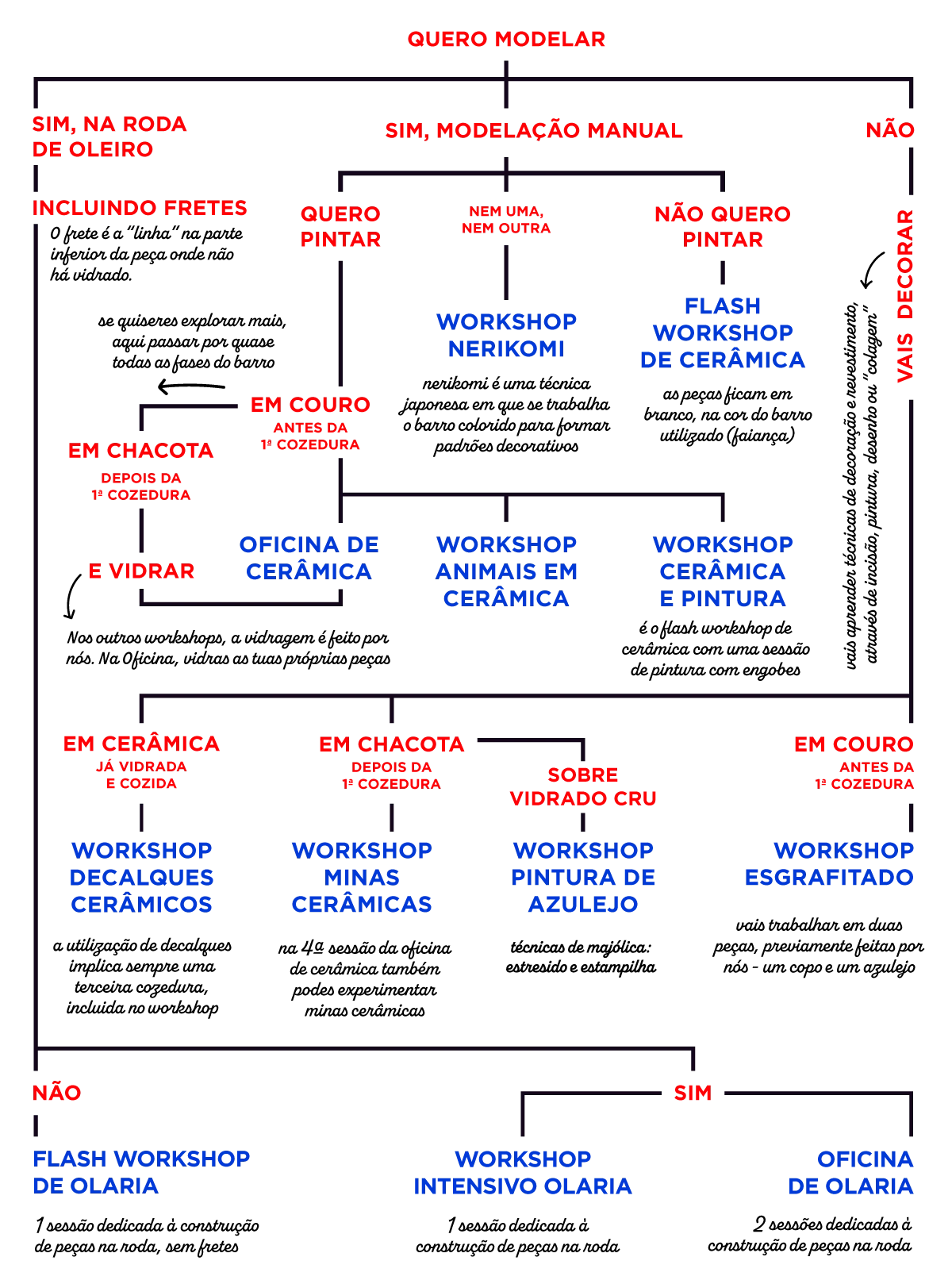
It sounds complicated, but you can find the answer simply: do you want to model clay, by hand or on the wheel? Do you want to decorate it, before or after the first firing?
You see, the ceramics workshops at FICA cover quite a few different things, and realizing this before you sign up saves confusion afterwards. What we can do is explain what happens, what you learn, and what you don't learn, so that the decision is informed and not based on misplaced expectations.
⧗ reading time - 6 to 7 minutes ⧗
First: do you want to model or not?
If you're wondering how to choose the right ceramics workshop for you, this is the first step. Modeling is taking raw clay and shaping it with your hands, building a bowl, a vase, a figure. It's what most people imagine when they think of ceramics.
But there is another possible entry point: working on pieces that have already been made and fired, applying decorative techniques, exploring finishes. Neither is more or less ceramic, they are simply different entry points.
If you're not sure, the most honest answer is: try modeling first. It's easier to see if it tells you something.
Next, we tried to answer the question of “how to choose a ceramics workshop” by dividing the workshops into types.
❯ I want to model by hand and paint
Do you want to model: by hand or on the wheel?
Hand modeling is the starting point for almost everyone. You work the clay directly with your hands, building the pieces using techniques such as balling, rolling or solid hollowing.
You don't need special coordination or previous experience. Of course, some will do better than others. It's not a competition. We often say that it's only easy for those who don't do it. And for us, having you in a workshop to learn is already an incredible step.
The potter's wheel is another discipline. Centering the clay on the wheel requires repeated practice, is less intuitive at first, and frustration is part of it. It's not easy from a physical point of view, and it requires patience.
If your goal is to find out if ceramics is for you, starting with hand modeling usually makes the most sense. But if you like a challenge, deal well with frustration or the potter's wheel has always been a desire, pottery is also a very valid entry point.
❯ Hand modeling workshops, without painting
FLASH CERAMICS WORKSHOP - 3 hours, one session. You build pieces using two techniques: ballast and ball. You don't paint, you don't glaze. We do the firing and glazing. It's the most direct way to find out if you like working with clay. The pieces are white, in the color of earthenware. [60€]
❯ Hand modeling workshops, with painting
CERAMICS AND PAINTING WORKSHOP - 6 hours, morning and afternoon. The morning session is the same as the Flash Ceramics Workshop, but in the afternoon you have the opportunity to paint the pieces you have created with engobes. [100€]
CERAMICS WORKSHOP - 4 sessions of 3 hours, once a week. You learn four construction techniques, decoration techniques before (engobes) and after the first firing (paints, mines), and glaze your own pieces in the last session. It is the most complete course for those who want to understand the process and its stages, from raw clay to the glazing process. [165€]
How many phases does clay have? In this article we explain each of the stages of clay, what happens, what to do and what to avoid → PHASES OF CLAY: THE PROCESS OF TRANSFORMING CLAY INTO CERAMICS
CERAMIC ANIMAL WORKSHOP - 3 hours. Hand modeling with a focus on building animal shapes. Includes decoration. [55€]
NERIKOMI WORKSHOP - 3 hours. Clarification: This is not painting, but modeling and creating colored clay. Nerikomi is a Japanese technique in which colored clay is worked to form decorative patterns. These are created in the plastic phase, and the color is an integral part of the construction of the piece, not a colored coating applied on top. In the workshop, we color white clay with various colors. [65€]
Flash Workshop or Ceramics Workshop?
Which one should you choose?
It depends on what you want. But there are concrete differences between the two formats, and it's worth understanding them in this article before you decide.
❯ Potter's wheel workshops
FLASH POTTERY WORKSHOP - 3 hours, a session dedicated to building parts on the wheel. No freight (the freight is the line at the base of the piece where there is no glaze). The shortest format to try. [65€]
INTENSIVE POTTERY WORKSHOP - 6 hours, morning and afternoon. Includes 1 wheel building session and 1 freight session. [110€]
POTTERY WORKSHOP - 3 sessions of 2:30 hours, with 2 dedicated to building parts on the wheel and 1 to creating freights. The most complete course for those who want to work on the wheel with more time and repetition. [165€]
You don't want to model, just decorate?
If what interests you is not building pieces but working on them. Or if you've already learned the techniques of forming, there are four workshops based on pieces that have already been made.
❯ Decorating workshops (without modeling)
SGRAFFITO WORKSHOP - you work on pieces (a glass and a tile) in leather (before the first firing), with decoration and coating techniques: painting and incision. [55€]
CERAMIC MINES WORKSHOP - you work on pieces in chacota (after the first firing). In this workshop you will decorate (design) two plates. You can also experiment with ceramic mines in the 4th session of the Ceramics Workshop. [50€]
TILE PAINTING WORKSHOP - you work with majolica techniques that consist of painting with high-fire paints on raw glaze. [55€]
CERAMIC DECALS WORKSHOP - you'll be working with glazed and fired ceramics. You will create compositions for two plates. The use of decals always involves a third firing, which is included in the workshop. [50€]
So where to start?
If you've never touched clay and want to find out if ceramics is for you: Flash Ceramics Workshop. Three hours, no commitment, and you know if you want to continue.
If you want to understand, over several sessions, the complete process, from raw clay to glazed piece: Ceramics Workshop.
If the potter's wheel is what interests you from the start: Flash Pottery Workshop to try it out, Wheel throwing workshop if you want to work longer. Or Intensive Pottery Workshop, If you want to build and create freight, but don't have time to come once a week, like the Workshop.
If you want to explore decorating without building: any of the decorating workshops, depending on the type of finish you're interested in.
Ceramics Worshops
If you still don't know how to choose the right ceramics workshop for you.
Find out more about each workshop - the objective,
what techniques you learn, what you take, price and duration.
Frequently Asked Questions on How to choose a ceramics workshop
Do I need to have taken the Flash Ceramics Workshop before signing up for the Workshop?
No. The two are independent. The Ceramics Workshop starts from scratch, so you can go straight into it without having gone through the Flash Workshop. The difference isn't the level, it's the time and what you can cover in each format.
The same applies to the Flash Pottery Workshop and the Pottery Workshop
Can I try the potter's wheel without ever having touched clay?
Yes, you can do any of the pottery workshops without ever having touched clay.
In decorating workshops, are the pieces already made?
Yes. In the Esgrafitado, Minas Cerâmicas, Pintura de Azulejo and Decalques Cerâmicos workshops, the pieces you will be working on are already ready when you arrive. The focus is entirely on the decoration technique, there is no modeling.
What clays do you use in your workshops?
We use different clays (ceramic pastes) for hand modeling and potter's wheel workshops.
For hand-modeling, such as the ceramic flash workshop and the ceramics workshop, we use earthenware, which is white.
We've used red clay for the potter's wheel, but at the moment we're using terracotta from the Graffito.